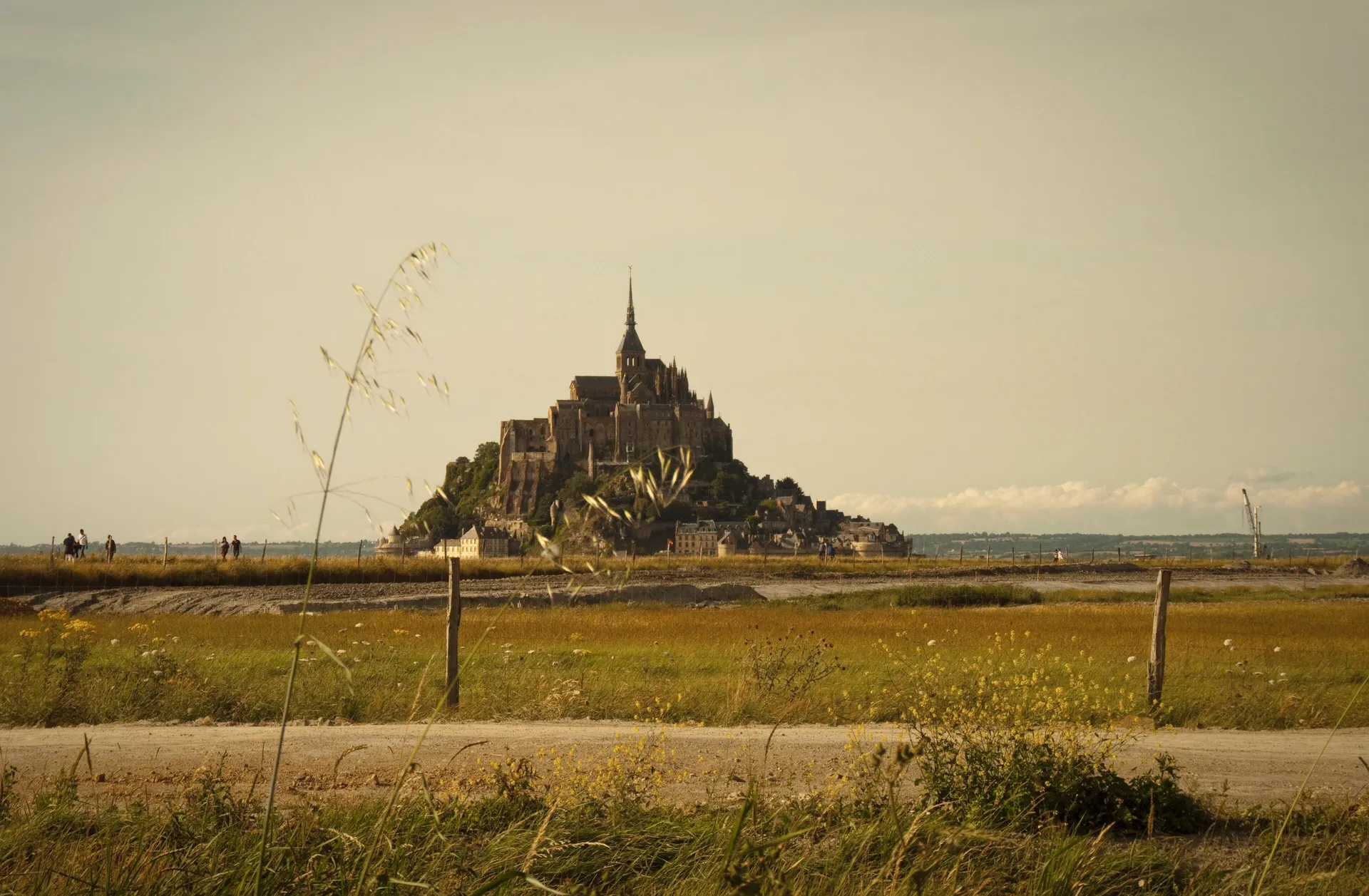
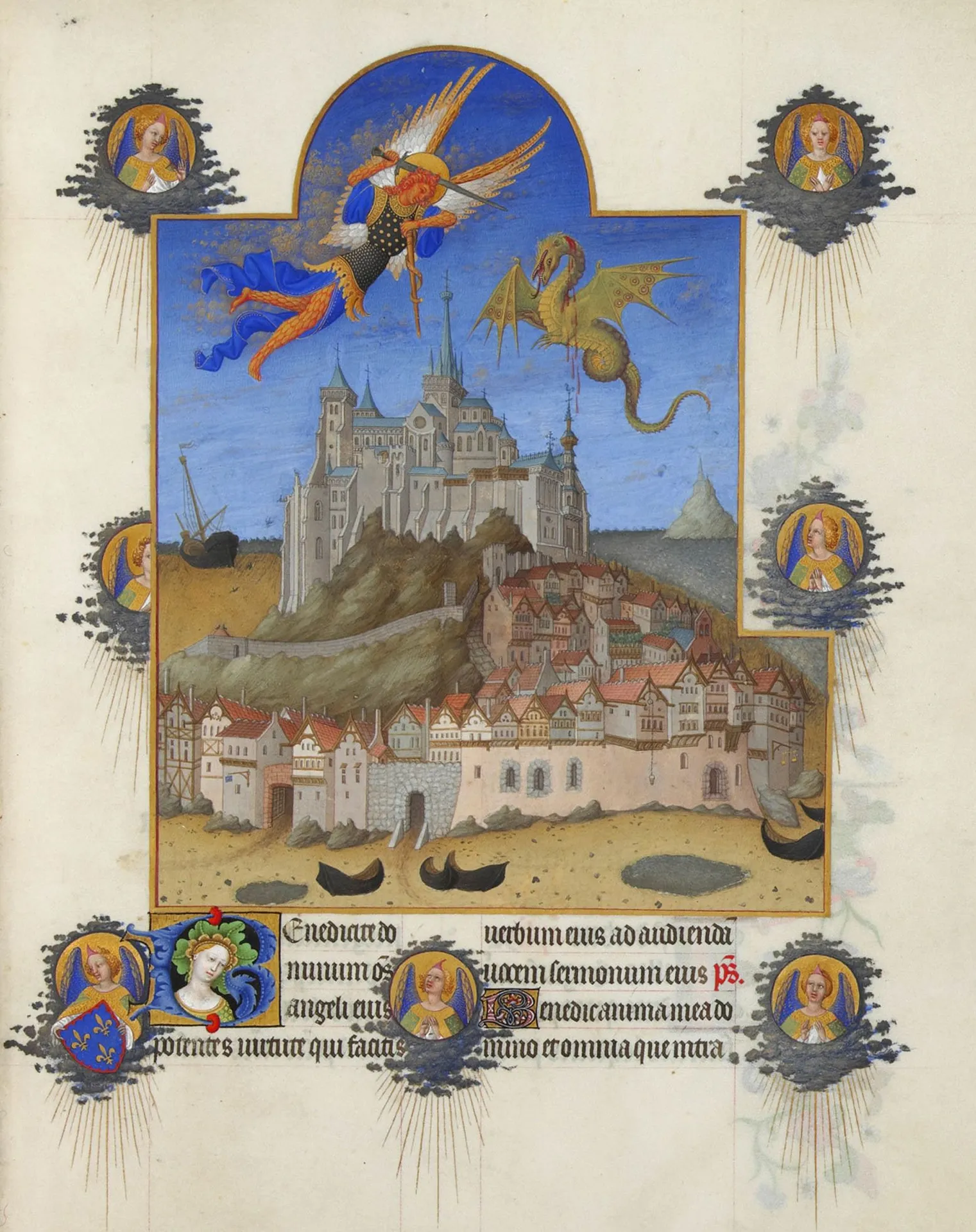
In short
- 708: Bishop Aubert of Avranches founds a sanctuary to Saint Michael on Mont Tombe after three visions.
- 966: Benedictine monks arrive; the Romanesque church is begun in 1023 and the Gothic Merveille follows in the early 1200s.
- 1423–1434: the Mont holds out against an English siege and becomes a symbol of French resistance.
- From the 18th century to 1863 the Abbey is a prison; restoration begins in 1874 and the golden archangel crowns the new spire in 1897.
- 1979: UNESCO World Heritage. 2014: a bridge replaces the causeway as the bay's maritime character is restored.
Mont Tombe and Bishop Aubert (to 966)
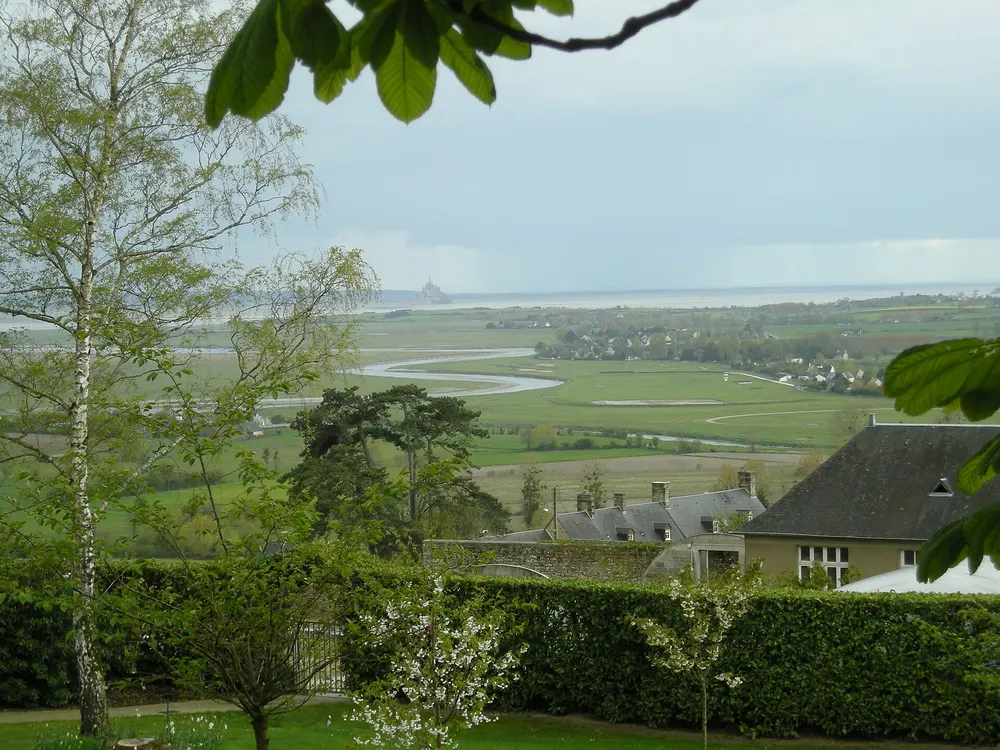
Before it belonged to Saint Michael, the rock was called Mont Tombe, a granite island rising from marshes and forest that the sea was slowly turning into a tidal bay. Hermits built small oratories on it in the 6th and 7th centuries.
According to the abbey's founding legend, written down about a century later, the archangel Michael appeared three times in dreams to Aubert, bishop of Avranches, in 708, asking him to build a sanctuary on the rock. Aubert hesitated until the angel, losing patience, touched his skull with a finger. A skull with a hole in it, venerated as Aubert's, is still kept in the treasury of the Saint-Gervais basilica in Avranches.
Aubert sent monks to the great Italian sanctuary of Saint Michael at Monte Gargano in Apulia, who brought back relics – by tradition a fragment of the archangel's red cloak and a piece of the altar stone. The first church, a cave-like oratory for about a hundred people, was dedicated on 16 October 709. Canons served it for two and a half centuries, and pilgrims began to come.
The Benedictines and the Romanesque abbey (966–1204)
In 966 Richard I, Duke of Normandy, installed a community of Benedictine monks under the Rule of Saint Benedict. The Mont became one of the great abbeys of the Norman duchy and a centre of learning, whose scriptorium produced the illuminated manuscripts now shown at the Scriptorial in Avranches.
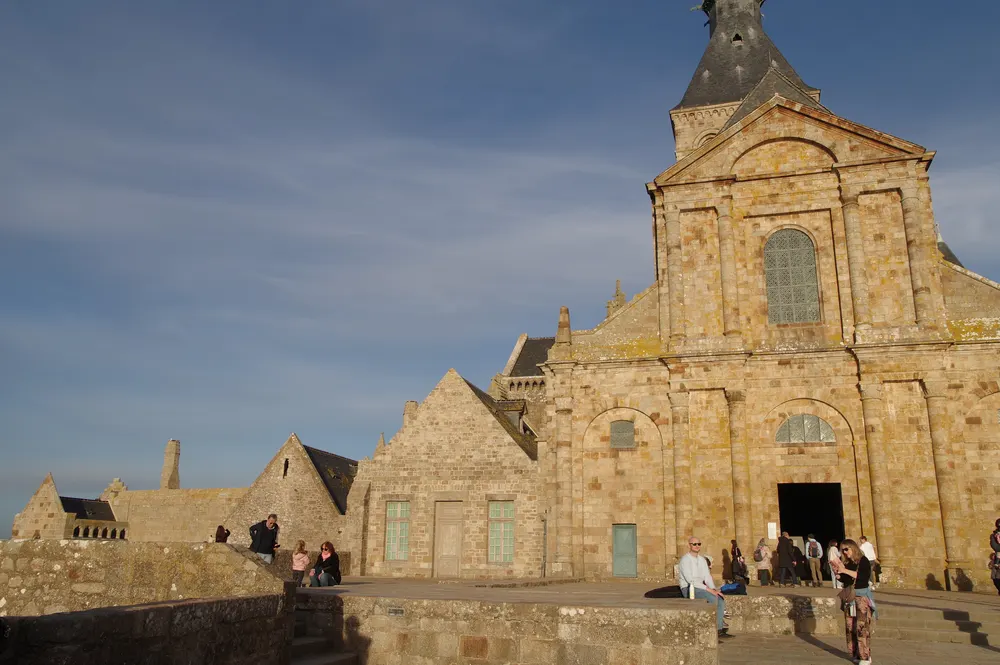
Work on the Romanesque abbey church began, by tradition, in 1023. Because the summit was too small, the builders created a platform of crypts around the peak and set the church on top – which is why the visit goes up and down so many levels. The monastery buildings of the 11th and 12th centuries survive beneath the West Terrace.
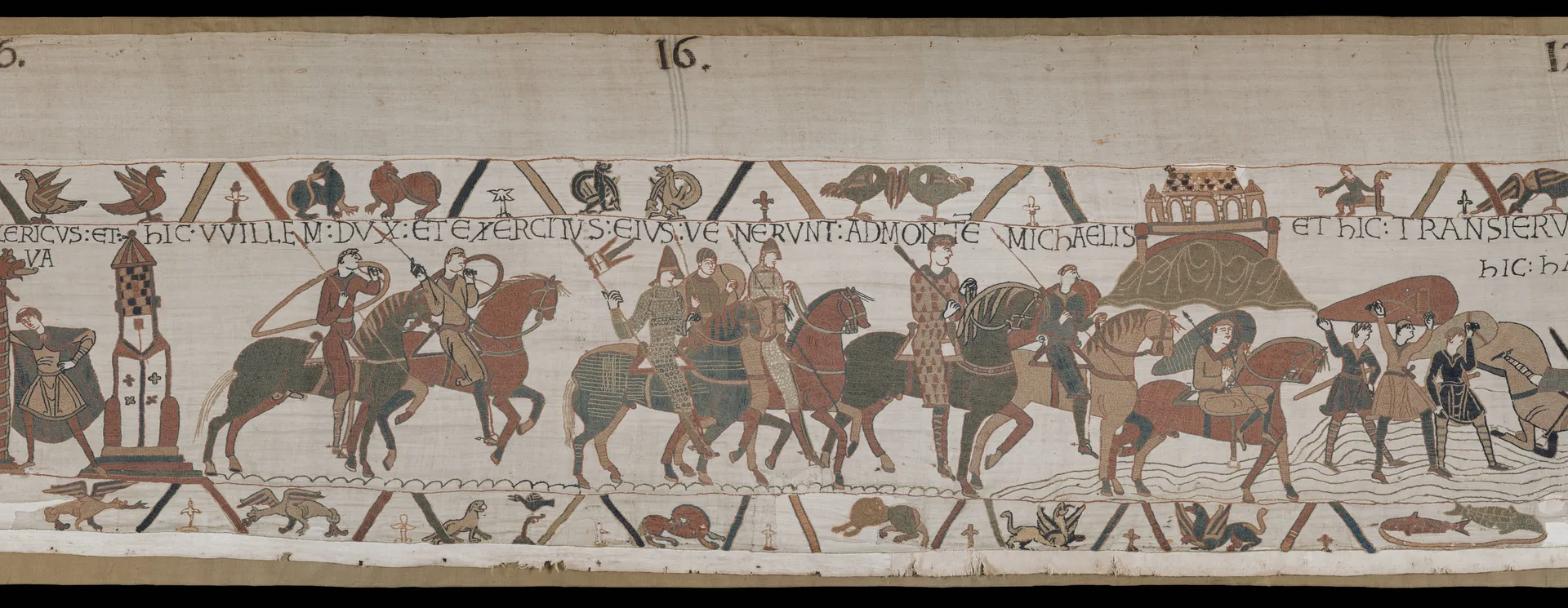
The Mont also appears in the Bayeux Tapestry: in the 1060s, Duke William's army, with Harold of England, passes the Mont on its Breton campaign, and Harold is shown pulling soldiers out of the quicksand of the Couesnon – an early record of the bay's dangers.
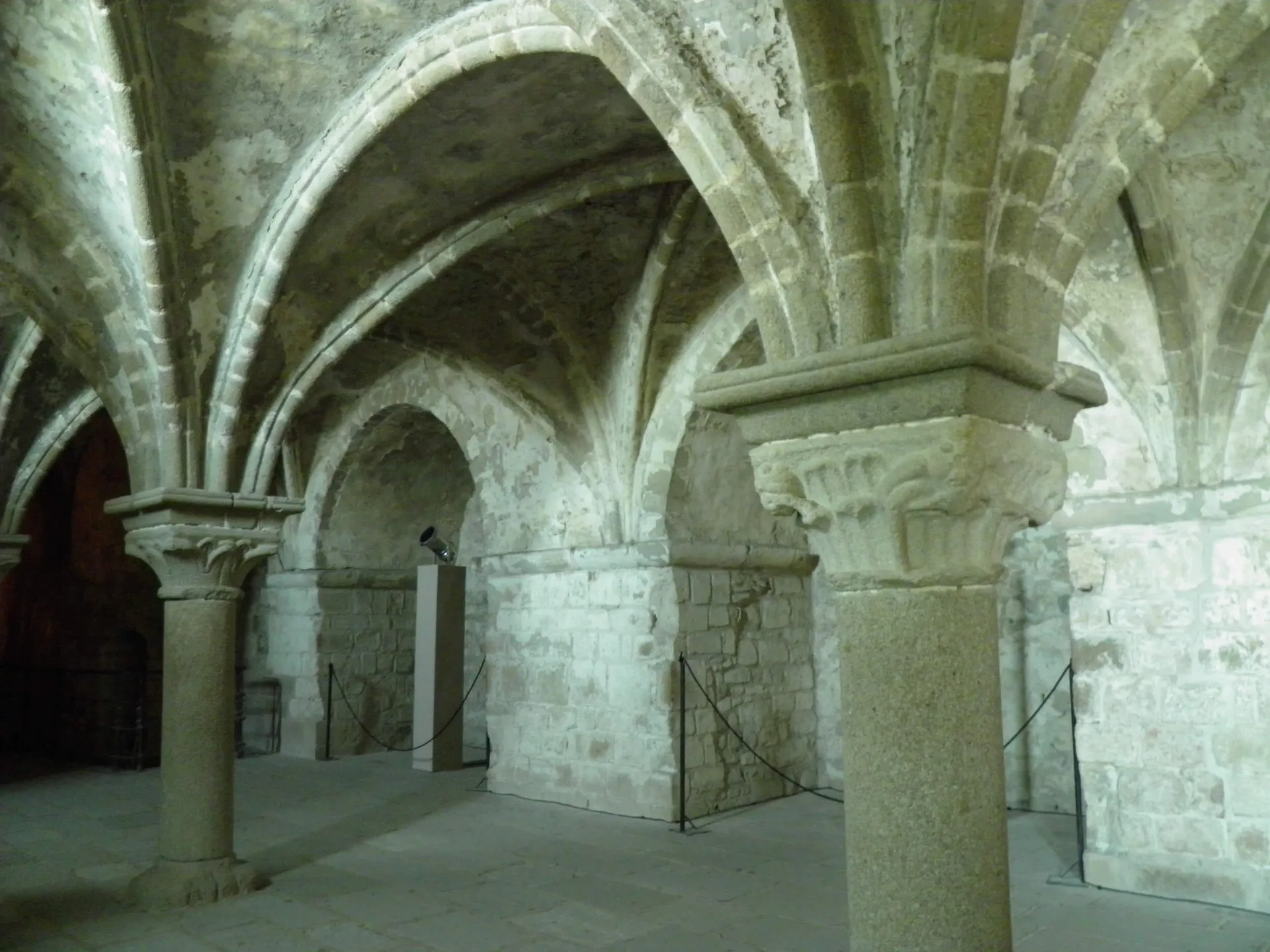
The Monks' Walkway (Promenoir des moines), part of the 12th-century Romanesque monastery.
La Merveille and the pilgrims (1204–1400)
In 1204, Breton troops allied with the French king Philip Augustus attacked and set fire to the Mont during his conquest of Normandy. The king financed the rebuilding, and between about 1211 and 1228 the monks raised La Merveille, the two three-storey Gothic buildings on the north face, crowned by the cloister.
Through the Middle Ages the Mont was one of the great pilgrimages of Western Christendom. Pilgrims called miquelots came from across France and beyond, crossing the bay on foot at low tide with guides – and sometimes dying in the quicksand or the incoming tide. They bought lead badges and scallop shells, and many travelled on towards Santiago de Compostela, which is why the Mont is part of UNESCO's "Routes of Santiago de Compostela in France". In the late Middle Ages even bands of children set off on pilgrimage to the Mont.
The town grew below the abbey to house and feed them, along what is still the Grande Rue.
The Hundred Years' War: a fortress that never fell (1356–1450)
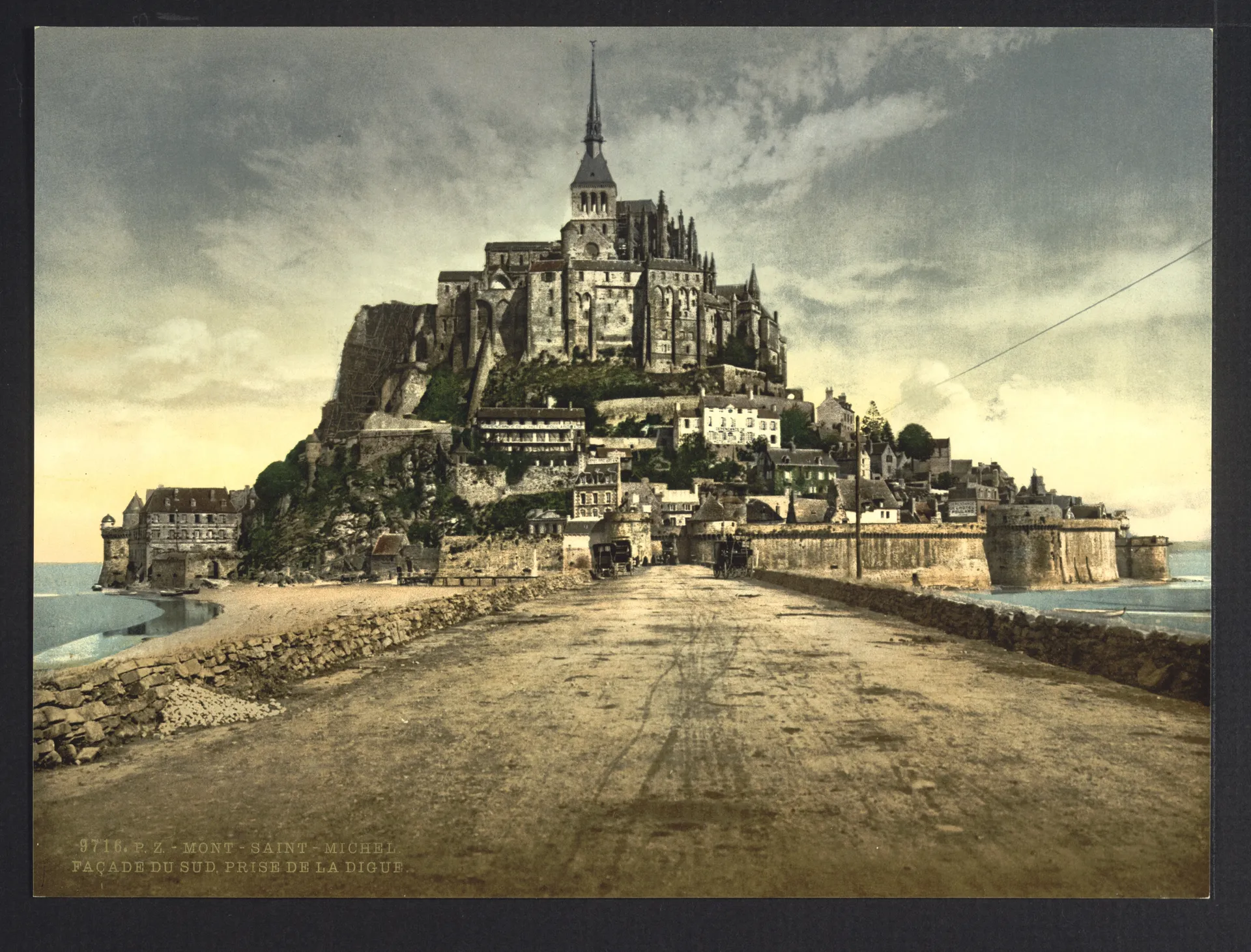
During the Hundred Years' War, Normandy fell to the English but the Mont did not. The abbey was fortified, the town walls were built and rebuilt, and in 1421 the Romanesque choir collapsed – it would later be rebuilt in Flamboyant Gothic.
From 1423 the English besieged the Mont, holding the neighbouring islet of Tombelaine as a base. Under its captain Louis d'Estouteville (from 1424), a garrison of French knights held out, supplied by sea from Brittany. A last major English assault failed on 17 June 1434; the attackers left behind two great iron bombards, the Michelettes, still displayed inside the Avancée gate.
The Mont became a symbol of French resistance and of the king's cause; in 1469 Louis XI founded the chivalric Order of Saint Michael and set its chapter at the abbey.
Decline, the Maurists and the "Bastille of the seas" (1500–1863)
The new Flamboyant Gothic choir was completed in the early 16th century, but the abbey's golden age was over. Abbots were now appointed by the king and often absent. In 1622 the reforming Benedictines of the Congregation of Saint-Maur (the Maurists) took over.
Already under the Ancien Régime, the monks had to hold prisoners sent by royal lettre de cachet, and the Mont acquired the nickname "Bastille of the seas". The Revolution expelled the last monks, renamed the island Mont-Libre and turned the abbey into a prison, first for refractory priests and later, from the early 19th century, as a large state prison. Inmates worked in the abbey's halls, and the giant treadwheel still on the visit hoisted supplies up the cliff. Famous political prisoners included the republicans Armand Barbès and Auguste Blanqui.
Writers including Victor Hugo, who visited in 1836, protested at the state of the building. Napoleon III closed the prison in 1863.
Restoration, the spire and the golden archangel (1874–1897)
In 1874 the abbey was classified as a Historic Monument and the long restoration began, led first by the architect Édouard Corroyer and then by his successors. They stripped out prison partitions, rebuilt the cloister and repaired La Merveille.
The most visible change came in 1897: architect Victor Petitgrand gave the church a new neo-Gothic bell tower and spire, and on top of it was placed a gilded copper statue of Saint Michael slaying the dragon by the sculptor Emmanuel Frémiet. About four metres tall, it stands roughly 157 metres above the shore. It was restored in 1987 and, in 2016, lifted off by helicopter for restoration and regilding before being returned to the spire.
Meanwhile the Mont had become a tourist destination. A causeway road was built in 1879, a tramway once ran along it, and in 1888 Annette Poulard opened the inn that made her omelette famous (food).
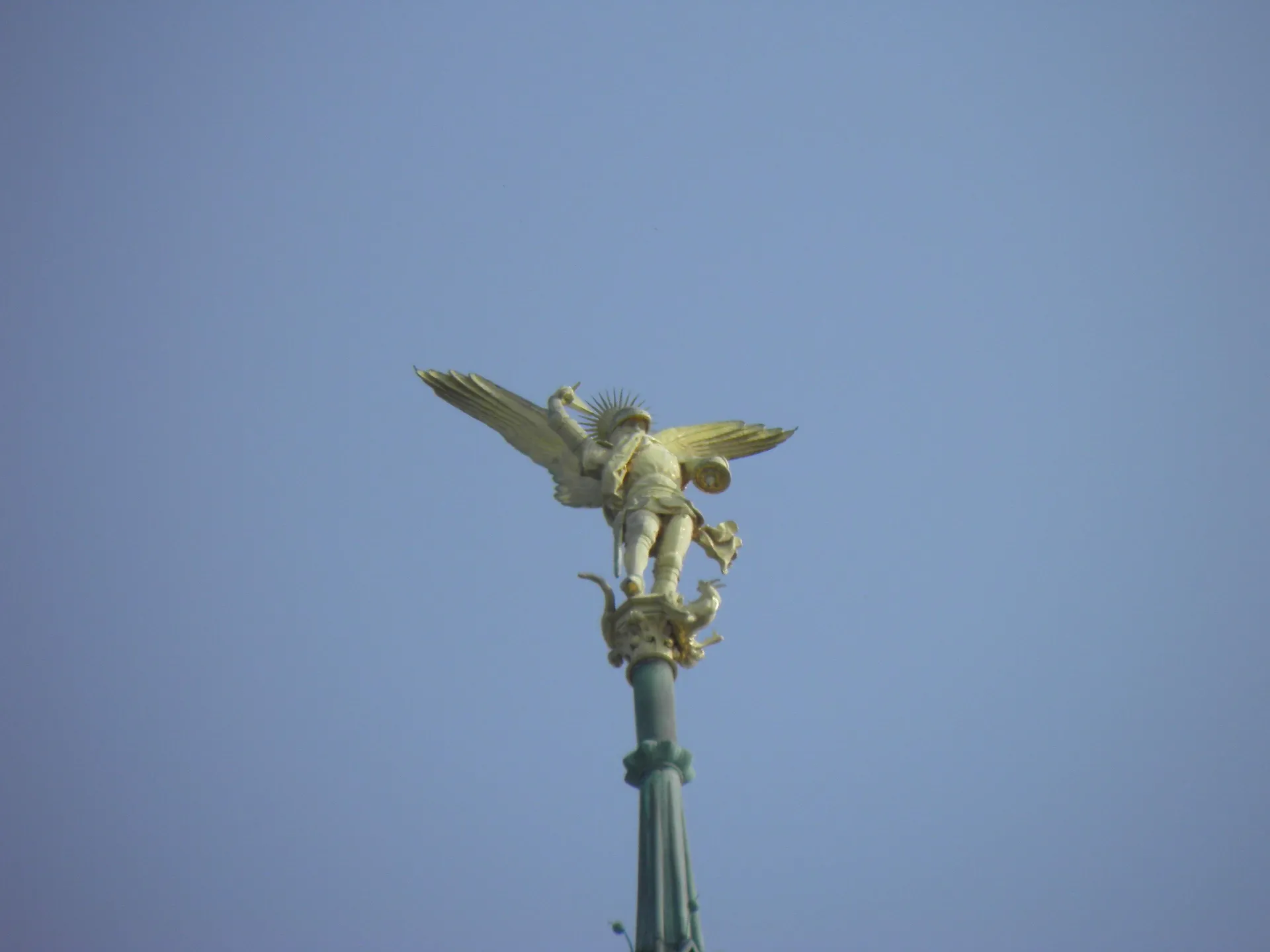
Frémiet's gilded Saint Michael, placed on the spire in 1897 and regilded in 2016.
The 20th century: monks return and UNESCO (1900–2000)
The Mont came through the Second World War, including the German occupation, without serious damage. In 1966 the abbey celebrated its monastic millennium, and a small Benedictine community moved back. In 1979 "Mont-Saint-Michel and its Bay" was inscribed on the UNESCO World Heritage List, and in 1998 the Mont was included in the serial site of the Routes of Santiago de Compostela in France.
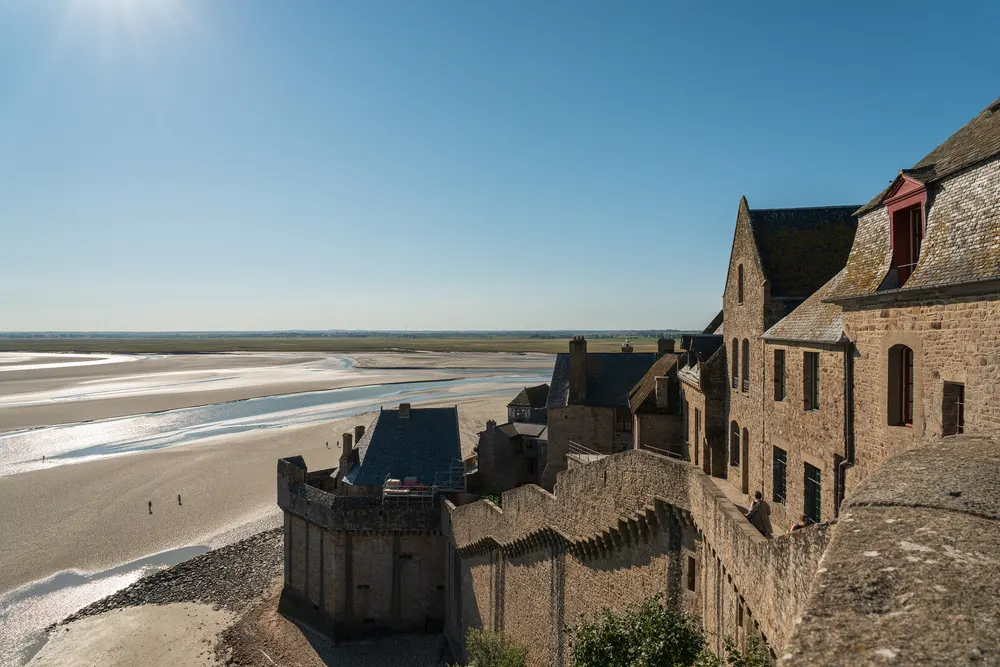
But the causeway, car parks on the sands and earlier land reclamation had let silt build up around the rock. By the 1990s salt meadows were advancing towards the walls, and experts warned the Mont would one day be permanently on dry land.
Giving the Mont back to the sea (1995–2015)
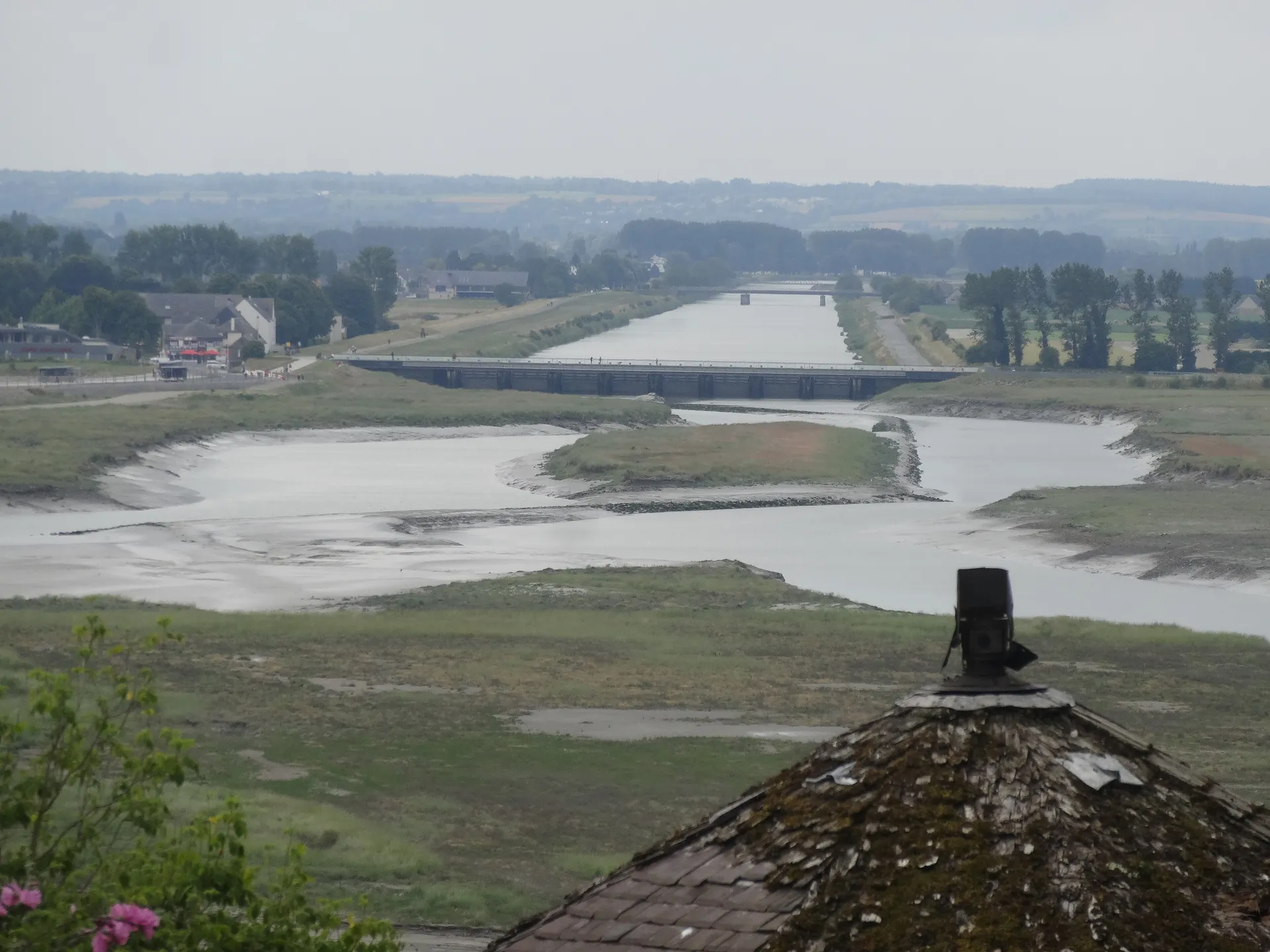
In 1995 the State and local authorities launched the project to restore the maritime character of the Mont. A new dam on the Couesnon (built 2006–2009) holds back sea water at high tide and releases it at low tide to flush sediment away from the rock. The car parks moved to the mainland in 2012, the free shuttle Le Passeur began running, and on 22 July 2014 a light bridge-walkway designed by Dietmar Feichtinger – 756 metres long – opened in place of the old causeway, which was then removed.
The bridge ends at a low esplanade that the sea covers on the very biggest tides, so the Mont becomes an island again on a few days a year. Since 2001 the abbey has been home to the Monastic Fraternities of Jerusalem, and the CMN has continued restoring the cloister, the statue and La Merveille. See high tides for today's island days.
Mont-Saint-Michel at a glance
Mont-Saint-Michel is in Normandy, not Brittany – a perennial question, because the Brittany border runs along the Couesnon a few hundred metres away and the bay is shared by both regions. Practical details: getting there and practical info.
- Where
- Le Mont-Saint-Michel, a commune in the Manche department, Normandy region, France
- Border
- The Couesnon river, just west of the Mont, separates Normandy from Brittany
- Inhabitants
- 23 (INSEE census, 2023)
- Commune area
- About 4 km² (INSEE)
- Founded
- Sanctuary 708–709; Benedictine abbey from 966
- Protection
- Abbey a Historic Monument since 1874; Mont-Saint-Michel and its Bay on the UNESCO World Heritage List since 1979
- Visitors
- About 2.8 million to the site in 2025 (CCI Normandie figures); 1,627,042 to the Abbey
- Managed by
- Abbey: Centre des monuments nationaux · site and access: Établissement public national du Mont-Saint-Michel
- Distances by road
- Paris about 360 km via the A13 and A84 (about 4 h) · Rennes about 1 h 15 by coach · Saint-Malo about 1 h by coach
Timeline at a glance
- 6th–7th c.
Hermits on Mont Tombe
Oratories to Saint Symphorien and Saint Étienne.
- 708–709
Aubert's sanctuary
Three visions of Saint Michael; the first church is dedicated on 16 October 709.
- 966
Benedictines arrive
Installed by Duke Richard I of Normandy.
- 1023
Romanesque church begun
Built on crypts around the summit.
- 1060s
Bayeux Tapestry
William's army passes the Mont; Harold rescues men from the quicksand.
- 1204
Fire
Breton troops allied to Philip Augustus burn the Mont; the king funds rebuilding.
- 1211–1228
La Merveille
The Gothic monastery and cloister on the north face.
- 1421
Choir collapses
Later rebuilt in Flamboyant Gothic.
- 1423–1434
English siege
The Mont never falls; the Michelettes are left behind in 1434.
- 1469
Order of Saint Michael
Louis XI's chivalric order, with its chapter at the abbey.
- 1622
The Maurists
Reforming Benedictines take over the abbey.
- 1790s–1863
Prison
Monks expelled; the abbey serves as a prison until 1863.
- 1874
Historic Monument
Restoration begins.
- 1879
Causeway
A road links the Mont to the mainland.
- 1897
Spire and archangel
Petitgrand's spire and Frémiet's gilded Saint Michael.
- 1966
Millennium
Monastic life returns to the abbey.
- 1979
UNESCO
Mont-Saint-Michel and its Bay listed as World Heritage.
- 2001
Fraternities of Jerusalem
The current monastic community arrives.
- 2009
Couesnon dam
The new dam begins flushing sediment from the bay.
- 2014
The bridge
The bridge-walkway opens on 22 July; the causeway is removed.
- 2016
Archangel regilded
The statue is lifted by helicopter, restored and replaced.
Frequently asked questions
Who built Mont-Saint-Michel?
The first sanctuary was founded by Bishop Aubert of Avranches in 708–709. The abbey we see was built mostly by Benedictine monks from the 11th to the 16th centuries, with the Gothic Merveille in 1211–1228, and restored by state architects from 1874.
Was Mont-Saint-Michel ever captured?
No. During the Hundred Years' War it resisted an English siege from 1423 to 1434, even though the rest of Normandy was under English control.
Why was the Abbey a prison?
Its isolation made it a convenient jail: from the Ancien Régime, prisoners were held on royal orders, and after the Revolution the State used it as a prison until Napoleon III closed it in 1863.
When was the golden statue added?
In 1897, on top of Victor Petitgrand's new spire. The statue of Saint Michael is by Emmanuel Frémiet; it was restored in 1987 and regilded in 2016.
Why was the causeway replaced with a bridge?
The 1879 causeway and the car parks on the sand helped silt build up around the Mont. The 2014 bridge, the Couesnon dam and the removal of the causeway let the tides flow again.
Is Mont-Saint-Michel in Normandy or Brittany?
Normandy. The border with Brittany follows the Couesnon river just to the west – the subject of a famous local saying that the river's wanderings once put the Mont in Normandy.
Which region is Mont-Saint-Michel in?
Normandy. The commune of Le Mont-Saint-Michel is in the Manche department of the Normandy region, on the border with Brittany, which follows the Couesnon river just west of the Mont.
Sources and official information
Facts were checked against these official sources in November 2026. Opening hours, prices and timetables change, so confirm before you go.
- abbaye-mont-saint-michel.fr
- abbaye-mont-saint-michel.fr
- whc.unesco.org
- whc.unesco.org
- montsaintmichel.gouv.fr
- bayeuxmuseum.com
- scriptorial.fr
- insee.fr
- tourmag.com
- ulysse.com
- ot-montsaintmichel.com
MontSaintMichel.com is an independent guide, not the official site of the Abbey or of the Mont. Some links are affiliate links: tours and tickets go to GetYourGuide and hotels go to Booking.com, and we may earn a commission at no extra cost to you.